Cameras

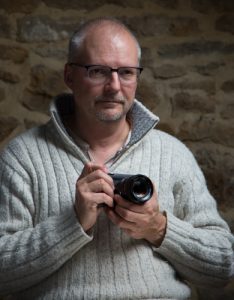
Jem Hayward with Canon 5D photo by Alison Rodwell
I’ve been trained in optics, I have lectured in optics, camera basics, exposure and would be described by many as technically competent, I have realised over the years that I’m not a camera collector and view the camera as just a tool for the job.
That doesn’t mean that any old camera will do, and my background in optics makes me intolerant of poor quality lenses.
In my film days I used Contax bodies, so I could use the excellent Carl Zeiss lenses, and still have two Zeiss lenses and use them regularly. The move into digital took me to Canon, as the EOS body is easy to adapt other lenses to, so much of the time I will be using a Canon digital body with a fully manual Zeiss lens on the front.
My current SLR camera bodies are a Canon 300D modified for infra red use, and a Canon 5D.
Bulky SLR cameras and lots of lenses can be a pain to carry around and can be intrusive in many circumstances, so I have just bought a Fuji X100 as my “point and shoot” camera.
The “legendary” Fuji X100
The amount of pre-launch hype this camera got was astonishing. This set up expectations that were almost impossible to fulfil. It wasnt exactly the type of camera I was looking for, and it has changed the sort of photography I do.
If you want to know technical details, and see as slightly over enthusiastic review, this is as good as any.
I have had a few small digital compacts, Canon and Fuji, and found them both useful (in the pocket) and frustrating (slow, awkward and over automated) and ultimately the images were rarely usable, as the quality wasnt quite good enough. Many years ago I regularly used a Rollei 35B and took some memorable images with it. Severely limited in many ways, it had a resonably good lens, and took good quality pictures. The final straw in my frustrating digital journey was a Fuji that had good startup time, 12 megapixels and the most agressive sharpening and jpg compression I’d ever seen, rendering the images next to useless, unless I shot everything in the so called “portrait” mode.
So, the hunt started for a small digital camera that placed image quality first. The new compact system cameras started to appear, and the idea of a compact camera onto which I could fit a range of lenses, and via adapters, my current lenses, was rather appealing. I went to Focus on Imaging to find my ideal camera. I looked at the various compact system cameras, but the lack of viewfinder and general over complex handling stopped me falling for any of them. I then found the X100 and although it offended several of my sensibilities, it felt nice in my hands.
The cons were many:
1. I don’t like retro as a general style.
2. I dont like things that pretend to be what they are not (at least theres no red dot on the front!).
3. I wanted interchangable lenses.
4. It was way more expensive than my budget.
The pros:
1. Handling – it has knobs, and you can operate it with gloves on.
2. It has a full (APS-C) sized sensor.
3. It seems to have been designed by photographers, not marketing executives.
4. It doesn’t have interchangeable lenses.
So, why is a fixed lens a pro, when it was a con?
This is a camera I will carry with me everywhere, every day, ready for “action”. If it was a “system” camera, I’d have to take several lenses, and all of a sudden my pockets are full. Yes, I could just take one lens, but if I decide that today its a 135mm telephoto, its no longer a compact camera, and shooting “on the street” is more wide angle territory, so maybe I go for a 40mm lens, more compact, or maybe a zoom, but what range and am I prepared to put up with the quality and aperture compromises?
Subsitute quality for zoom:
The Fuji has a 35mm equivalent lens. Its a very good quaility lens. The sensor is large, low noise and so the images are very sharp, so, if what I want is really an 80mm lens, I just crop. It works – see the barn picture on this site, its only about 30% of the image, but I can print it to A3 and it still looks sharp.
Ideally, I’d like the X100 to be faster in operation, it does take a second or so to update the card when shooting RAW and jpg as I do, and like all digital cameras its got far too many options. However, its also got a lot of useful features, lots of ISO range, though 6400 is pretty noisy, but if it gets you that shot, without flash, its useful. At the other end of the scale ND filter allows you to shoot wide open (f2) to wallow in the lovely bokeh, even under quite bright conditions. You can sometimes beat the autofocus, but the manual focus is almost useless except for maybe close up shots. The electronic viewfinder I thought I wouldn’t use, but I do, as its really useful to see what the lens is seeing without paralax, and it also reflects exposure changes, so you can see the effect of exposure changes on the look and feel of your image.
The menu dial/button arrangement is a weak point, and the “jog” switch seems to be under-used, the fn button, with the new firmware is multi functional, but it would be nice if I could assign functions to the jog switch as well..
I use it most days, I take pictures of people, places and things that I see, that I would never do with my Canon. It is unobtrusive, subtle, easy to use and versatile. Its not a Leica M9 and if I had the funds, I’d have both, but probably would still use the X100 more.